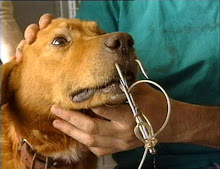
To find out what the ten names of the dog foods are you need to go over to Vet Tech there is a great article about the ten dog foods that may lead to cancer in your pet. Through a study that was taken by Colorado State University that is full of info to help keep your pet safe.
Check it out@ Vet Tech
Wednesday, January 12, 2011


One Feeds Cat To Dog While Two Shot A Dog In Bayou Blue, La.
What a sick week down in Bayou Blue, La., when a lowlife named Joshua Glasper threw a cat to a chained pit bull. Then you have two more lowlifes named Joey Plaisance and Justin Breaux that shot a dog on the side of the road. All three of them are now facing animal cruelty charges for what they did.
Read the article here.
Tuesday, January 11, 2011
Alaskan Dog Breeder Arrested And Charged With Animal Cruelty
Video by KTVA
The video shows some of the dogs that were rescued from a so called dog breeder named Frank J. Rick from Montana Creek, AK. After being charged with fifty counts of animal cruelty this bum has pleaded not guilty, can you imagine that.
The Matanuska Susitna Borough animal shelter have been putting in a lot of hours rescuing these poor dogs. There were supposedly one hundred and fifty seven dogs that were recovered and sixteen dogs that were dead at the breeder’s home.
Why does this have to happen when there are so many places out there that will help take care of your dogs. This guy could have even given some of his dogs away knowing that he couldn’t afford to feed them.
Read the article by Kyle Hopkins here.
Kyle Hopkins has posted a lot of ways to donate to the Matanuska Susitna Borough animal shelter if you care to help.
The video shows some of the dogs that were rescued from a so called dog breeder named Frank J. Rick from Montana Creek, AK. After being charged with fifty counts of animal cruelty this bum has pleaded not guilty, can you imagine that.
The Matanuska Susitna Borough animal shelter have been putting in a lot of hours rescuing these poor dogs. There were supposedly one hundred and fifty seven dogs that were recovered and sixteen dogs that were dead at the breeder’s home.
Why does this have to happen when there are so many places out there that will help take care of your dogs. This guy could have even given some of his dogs away knowing that he couldn’t afford to feed them.
Read the article by Kyle Hopkins here.
Kyle Hopkins has posted a lot of ways to donate to the Matanuska Susitna Borough animal shelter if you care to help.
Have An Old Dog, Here Are Some Tips
Top Ten Tips For Caring For An Old Dog
Dog owners know to put a coat on their dog when they take her out in cold weather, but what about at night, when thermostats are lowered to save money? The issue becomes especially important for older dogs who, just like older people, do not adapt easily to abrupt changes in temperature. Make sure the canine remains comfortable by putting her in a fuzzy dog bed, perhaps with a blanket over her. Hot air rises toward the ceiling while cold air sinks to the floor where the dog sleeps.
That's just one of the many tips found in GOOD OLD DOG: Expert Advice for Keeping Your Aging Dog Happy, Healthy, and Comfortable, just out from the Faculty of the Cummings School of Veterinary Medicine at Tufts University and edited by world-renowned animal behaviorist Nicholas Dodman, BVMS (Houghton Mifflin Harcourt). Ten other tips for dog owners from GOOD OLD DOG:
1. If you fly with Fido, consider buying a climate-controlled pet carrier. The belly of the plane might be temperature-controlled, but not the tarmac in frigid or blazing hot weather.
2. Don't be seduced by the word "Senior" on packages of dog food. That's a marketing tool with no definition other than what the manufacturer wants it to mean. Instead, look for fine print that says the food went through animal feeding tests approved by the Association of American Feed Control Officials, or AAFCO.
3. Don't despair if your aging friend is experiencing urinary incontinence. There is now an arsenal of drugs - and even surgeries - to correct the problem.
4. Check to see if your dog waddles or shuffles when she walks. It could be a sign of arthritis. Limping is not the only clue.
5. Consider buying health care insurance for your older pet. For about $50 a month, and sometimes much less, you can considerably diminish the cost of an expensive surgery or other procedure your older friend may need.
6. If your canine companion stands at the hinge side of a door to go through or gets "stuck" in corners or behind furniture, take her to the vet for a workup. She may have the canine version of Alzheimer's, and the sooner you tend to it, the better your chances of slowing its progression.
7. Put runners down on smooth surfaces like highly polished floors. They may not look good, but aging dogs often have a harder time gaining traction on a smooth surface or getting up from a reclining position.
8. Think your dog may be sick? Take his temperature. Normal is a range - 100 to 102.5 degrees Fahrenheit.
9. Don't smoke. Second-hand smoke is thought to raise the cancer risk for dogs (and other animals), just like it does for people. Even third-hand smoke - the tobacco toxin leftovers that stick on skin, hair, drapes, and so on - can make its way to your dog's lungs.
10. Don't fret if your dog needs abdominal surgery. For people, it can take 6 weeks after an abdominal operation to walk without pain. But people have to use their abdominal muscles to keep themselves upright when they walk, since they only have two legs. Because a dog has four legs, however, all her abdominal muscles have to do is hold in her organs, not expand and contract every time she takes a step. She can generally walk the day of the surgery.
The Faculty of the Cummings School of Veterinary Medicine at Tufts University treat more than twenty-six thousand cases annually, and the school's emergency program is the largest residency program in the United States. They are the authors of Puppy's First Steps.
Nicholas Dodman is a world-renowned animal behaviorist and the best-selling author of the immensely popular The Dog Who Loved Too Much, The Cat Who Cried for Help, and The Well-Adjusted Dog. He has appeared on Oprah, the Today show, Good Morning America, 20/20, and CNN, among many other television and radio programs. He is available for interview about Good Old Dog.
Lawrence Lindner is a New York Times best-selling writer who has penned regular columns for the Washington Post and the Boston Globe and has written for numerous other publications.
Source:
Houghton Mifflin Harcourt
Monday, January 10, 2011
1.1 Million Homeless Animals Adopted In Just 96 Days
1.1 MILLION HOMELESS ANIMALS ADOPTED IN JUST 96 DAYS THROUGH 2010 IAMS HOME 4 THE HOLIDAYS PET ADOPTION DRIVE
Annual Adoption Program Also Donates 5 Million Meals to Participating Shelters
One of the world’s largest pet adoption campaigns, Iams Home 4 the Holidays (IH4TH) announced today that 1,125,667 animals were adopted between Oct. 1 and Jan. 4. Iams and longtime partner Helen Woodward Animal Center, along with more than 3,500 animal organizations from around the world once again joined forces to help reduce pet homelessness.
Forever homes were found for:
593,146 dogs
509,470 cats
23,051 other animals (including rabbits, reptiles, horses, birds and more)
“With all the hard work that animal organizations do every day, we’re thrilled to be able to support those efforts and shine an even brighter light on the issues and the importance of pet adoption each year with this program,” said Mike Arms, founder of Iams Home 4 the Holidays and president of Helen Woodward Animal Center. “We’re all very proud of the successes we’ve had over the years and will continue to work together in the hopes that one day every homeless pet will be in a loving home for all their holidays.”
Understanding that not everyone is in the position to adopt a pet, Iams wanted to make it easy for more people to get involved and help make a difference by creating the Bags 4 Bowls food drive. Consumers could either purchase specially-marked bags of pet food or interact on the Facebook page (www.facebook.com/iams) to help donate bowls of pet food to participating organizations. An incredible success, the food drive reached its goal and Iams is donating 5,000,000 meals to participating animal organizations.*
“We’re proud that we’ve been a part of this program since it began in 1999 and we’ve helped more than 5 million pets find loving homes," said Maria Beatriz Rodriguez, Iams general manager. "We’re dedicated to continuing our mission with our partner animal organizations to ensure more and more pets find their forever homes.”
The 2011 program will begin in October. To learn how to get involved and make a difference in the life of an orphaned pet, visit http://www.facebook.com/iams for ways to adopt, donate or volunteer.
About Iams Home 4 the Holidays (IH4TH)
As one of the most successful pet adoption programs in the world, IH4TH partners with thousands of animal organizations dedicated to finding forever homes for orphaned pets. Founded by Helen Woodward Animal Center and supported by Iams, IH4TH began in 1999 with just 14 participating animal shelters in San Diego County. Since it began 12 years ago, IH4TH – along with more than 3,500 pet adoption centers – has helped 5.8 million families experience the joy of pet adoption, including more than 1.2 million pet adoptions from 2010. For more information, please visit www.facebook.com/iams.
About Helen Woodward Animal Center
Helen Woodward Animal Center is a private, non-profit organization where “people help animals and animals help people.” Founded in 1972 in Rancho Santa Fe, Calif., the Center provides services for more than 57,000 people and thousands of animals annually. Helen Woodward Animal Center is also the creator of the international Home 4 the Holidays pet adoption drive and the Animal Center Education Services program, teaching the business of saving lives to animal welfare leaders from around the world.
About P&G Pet Care
For more than 60 years, P&G Pet Care (NYSE:PG), the maker of Iams and Eukanuba, has enhanced the well-being of dogs and cats by providing world-class quality foods and pet care products. To learn more about Eukanuba® and Iams® Dog & Cat Foods or general pet care and nutrition information, call the Consumer Care Center at (800) 446-3075. You can also visit us on the Web at www.iams.com or www.eukanuba.com.
About Procter & Gamble
Four billion times a day, P&G brands touch the lives of people around the world. The company has one of the strongest portfolios of trusted, quality, leadership brands, including Pampers®, Tide®, Ariel®, Always®, Whisper®, Pantene®, Mach3®, Bounty®, Dawn®, Gain®, Pringles®, Charmin®, Downy®, Lenor®, Iams®, Crest®, Oral-B®, Duracell®, Olay®, Head & Shoulders®, Wella®, Gillette®, Braun® and Fusion®. The P&G community includes approximately 127,000 employees working in about 80 countries worldwide. Please visit http://www.pg.com for the latest news and in-depth information about P&G and its brands.
Sunday, January 9, 2011
USA TODAY'S "MOST HEROIC DOG OF 2010"
NOMINEES OF USA TODAY'S "MOST HEROIC DOG OF 2010" TURN THEIR VOTES INTO VOICES FOR FELLOW NOMINEE, TARGET.
TARGET WAS ERRONEOUSLY EUTHANIZED AFTER SAVING LIVES IN AFGHANISTAN

USA Today has narrowed the field down to five dogs in the running for Most Heroic Dog of 2010. Surf Dog Ricochet, the SURFice dog, and Sparkles the Fire Safety Dog have made the top five, along with Target, the Afghanistan dog who saved many soldiers lives, only to lose hers to an erroneous euthanization. Ricochet & Sparkles have turned their votes into voices for Target, and are now raising funds and awareness for her.
Voting for the five nominees in USA Today's Most Heroic Dog of 2010 started on Friday, January 7th. Ricochet and Sparkles were honored to be among the five nominees. They began asking their supporters for votes, but quickly joined together, and turned their energy toward fellow nominee, Target. They are asking people to turn their votes for them into voices by helping with their fundraiser for Target's cause, Target's Bunker, a no kill shelter founded by Target's family.
On the night of February 11, 2010, Target saved the lives of many soldiers in Afghanistan when a suicide bomber walked into a Border Patrol compound. Target, along with two other stray dogs, sensed something was wrong, and attacked the bomber. Despite the bombing... she survived. SGT Terry Young adopted Target, and brought her back to live with him in Arizona. One Friday afternoon, Target got out of the yard, and ended up in a shelter. Tragically, by Monday morning, she was erroneously euthanized. "Target's Bunker" has been formed with the hope of keeping another tragedy like Target's from happening ever again.
Ricochet and Sparkles agree... not only is Target USA Today's Most Heroic Dog of 2010, but she is THEIR hero! After contacting Target's family, they began reaching out to their voters, supporters, donors, and the world to help them raise awareness. Since "Target's Bunker" is still in it's infancy stages of development, the fundraising campaign is being held through Puppy Prodigies/Surf Dog Ricochet, a 501(c)3 non profit organization. Tax deductible donations are being accepted on behalf of "Target's Bunker". Please visit http://www.SurfDogRicochet.com/Target for more information, to make a donation, and to help Ricochet and Sparkles raise awareness of their hero, Target.
Ricochet and Sparkles thank USA Today for giving them such an amazing honor, but more importantly for pointing them in the direction of Target!
For more information, contact Judy Fridono/SurfDog Ricochet at pawinspired@aol.com, 707-228-0679, or Dayna Hilton at dayna@sparklesthefiresafetydog.com 479-979-7328.
http://www.Targetsbunker.org
http://www.sparklesthefiresafetydog.com/
http://www.SurfDogRicochet.com
TARGET WAS ERRONEOUSLY EUTHANIZED AFTER SAVING LIVES IN AFGHANISTAN

USA Today has narrowed the field down to five dogs in the running for Most Heroic Dog of 2010. Surf Dog Ricochet, the SURFice dog, and Sparkles the Fire Safety Dog have made the top five, along with Target, the Afghanistan dog who saved many soldiers lives, only to lose hers to an erroneous euthanization. Ricochet & Sparkles have turned their votes into voices for Target, and are now raising funds and awareness for her.
Voting for the five nominees in USA Today's Most Heroic Dog of 2010 started on Friday, January 7th. Ricochet and Sparkles were honored to be among the five nominees. They began asking their supporters for votes, but quickly joined together, and turned their energy toward fellow nominee, Target. They are asking people to turn their votes for them into voices by helping with their fundraiser for Target's cause, Target's Bunker, a no kill shelter founded by Target's family.
On the night of February 11, 2010, Target saved the lives of many soldiers in Afghanistan when a suicide bomber walked into a Border Patrol compound. Target, along with two other stray dogs, sensed something was wrong, and attacked the bomber. Despite the bombing... she survived. SGT Terry Young adopted Target, and brought her back to live with him in Arizona. One Friday afternoon, Target got out of the yard, and ended up in a shelter. Tragically, by Monday morning, she was erroneously euthanized. "Target's Bunker" has been formed with the hope of keeping another tragedy like Target's from happening ever again.
Ricochet and Sparkles agree... not only is Target USA Today's Most Heroic Dog of 2010, but she is THEIR hero! After contacting Target's family, they began reaching out to their voters, supporters, donors, and the world to help them raise awareness. Since "Target's Bunker" is still in it's infancy stages of development, the fundraising campaign is being held through Puppy Prodigies/Surf Dog Ricochet, a 501(c)3 non profit organization. Tax deductible donations are being accepted on behalf of "Target's Bunker". Please visit http://www.SurfDogRicochet.com/Target for more information, to make a donation, and to help Ricochet and Sparkles raise awareness of their hero, Target.
Ricochet and Sparkles thank USA Today for giving them such an amazing honor, but more importantly for pointing them in the direction of Target!
For more information, contact Judy Fridono/SurfDog Ricochet at pawinspired@aol.com, 707-228-0679, or Dayna Hilton at dayna@sparklesthefiresafetydog.com 479-979-7328.
http://www.Targetsbunker.org
http://www.sparklesthefiresafetydog.com/
http://www.SurfDogRicochet.com
Saturday, January 8, 2011
How Many Object Names Can A Border Collie Comprehend
Some Dogs May Understand That Our Sounds Refer To Particular Objects: Border Collie Comprehends Over 1,000 Object Names
Researchers at Wofford College discovered that a Border Collie comprehends the names of over 1000 objects, differentiating between names of objects and orders to fetch them. This research deepens the findings of researchers in Germany, who had discovered a dog that knew the names of a couple of hundred objects. Important questions were left open as to how far a dog could go, and whether the dog really understood that the object names were nouns and not commands to retrieve the object.
John Pilley and Alliston Reid answered two central questions with their research: How large can a dog's vocabulary become if given extensive training? What do dogs actually understand when we use human language to communicate with them? These findings are published in the Elsevier journal Behavioural Processes.
The authors demonstrated that their dog, Chaser, learned the names of 1022 objects - no upper limit is apparent - they stopped training the dog after three years due to their time constraints, not because the dog could not learn more names. This study demonstrates Chaser's ability to learn the names of proper nouns, and her extensive vocabulary was tested repeatedly under carefully controlled conditions. The authors admitted that she remembered the names of each of her 1022 toys better than they could. Chaser's ability to learn and remember more than 1000 proper nouns, each mapped to a unique object, revealed clear evidence of several capacities necessary for learning receptive human language: the ability to discriminate between 1022 different sounds representing names of objects, the ability to discriminate many objects visually, an extensive vocabulary, and a substantial memory system that allowed the mapping of many auditory stimuli to many visual stimuli.
Their second experiment demonstrated that Chaser really understands that these are names, and not commands to fetch the object. In order to test independence of meaning of nouns and commands, the authors randomly combined nouns with commands to see if Chaser would produce the correct behavior toward the correct object in each trial. Without special training, Chaser responded to each combination correctly, even on the first trial, demonstrating that Chaser understood that the commands and proper-noun names had independent meanings. The dog understands that names refer to particular objects, independent of the action requested involving that object.
Their third experiment demonstrated that the dog also understands names for categories of objects or common nouns, and not just individual names or proper nouns. For instance, she learned that name "toy" referred to the 1022 objects she was allowed to play with, each with a proper-noun name. By forming categories represented by common nouns, Chaser mapped one label onto many objects. Chaser also demonstrated that she could map up to three labels onto the same object without error. For example, Chaser knew the proper-noun names of all objects used in the research. Chaser also mapped the common noun "toy" onto these same objects. Her additional success with the two common nouns "ball" and "frisbee" demonstrates that she mapped a third label onto these objects. Her demonstrations of one-to-many and many-to-one noun/object mappings reveal flexibility in the referential nature of words in border collies.
Each of these experiments showed that the dog could learn names using procedures involving associative learning. Their fourth experiment demonstrated that Chaser could also learn names by exclusion - inferred the name of a novel object by exclusion of familiar already-named objects. Retention of these names using this procedure was limited to short periods, however, just as usually observed with children.
According to Alliston Reid, "This research is important because it demonstrates that dogs, like children, can develop extensive vocabularies and understand that certain words represent individual objects and other words represent categories of objects, independent in meaning of what one is asked to do with those objects."
Additional research is needed to determine whether these impressive language abilities are shared by other breeds of dogs. This work encourages research into how the historical relationships between humans and dogs may have influenced the abilities of dogs to communicate with humans, and whether this influence is unique to dogs.
Notes:
"Border collie comprehends object names as verbal referents" by John Pilley and Alliston Reid. http://dx.doi.org/10.1016/j.beproc.2010.11.007
About the authors
John W. Pilley, Ph.D. is a retired professor of psychology at Wofford College in Spartanburg, SC, where this study was completed.
Alliston K. Reid, Ph.D. is Reeves Family Professor of Psychology at Wofford College in Spartanburg, SC, and currently serves as president of the Society for the Quantitative Analyses of Behavior.
Source:
Francesca Webb
Elsevier
Subscribe to:
Posts (Atom)